
Kamień węgielny naszego sukcesu
Elevator guide rails are critical structural components that ensure safe, stable, and precise vertical movement of elevator cars and counterweights. Among the various guide rail profiles available on the market, the T-type elevator guide rail remains the most widely used due to its balanced strength, ease of installation, and compatibility with modern elevator systems.
This article explains what a T-type elevator guide rail is, how it works, its key advantages, and where it is most commonly applied.
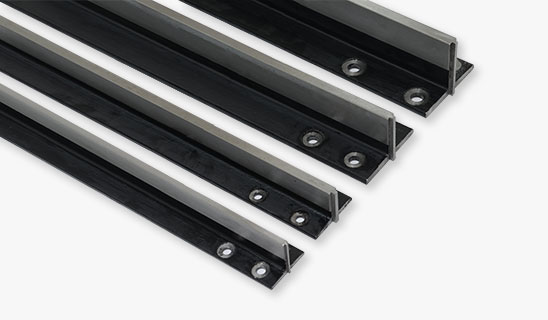
STOXH T-type Elevator Guide Rail (solid)
A T-type elevator guide rail is named after its distinct T-shaped cross-section. This profile consists of a vertical web and a horizontal head, forming a symmetrical structure designed to guide elevator cars and counterweights smoothly along the shaft.
Typically manufactured from high-quality carbon steel through cold drawing or machining processes, T-type guide rails feature:
• Precisely machined guiding surfaces
• High dimensional accuracy and straightness
• Consistent hardness and wear resistance
The head of the T-type rail serves as the primary contact surface for the elevator guide shoes, while the web provides structural rigidity and load distribution. This simple yet effective structure makes T-type rails suitable for a wide range of elevator configurations.
In an elevator system, T-type guide rails function as fixed tracks that control the vertical movement of both the elevator car and the counterweight. Installed along the elevator shaft and securely fastened to guide rail brackets, the rails maintain alignment throughout operation.
As the elevator travels, guide shoes—either sliding or roller types—remain in constant contact with the guiding surfaces of the T-type rail. This interaction:
• Prevents lateral movement and vibration
• Ensures accurate stopping at each floor
• Maintains stability during acceleration, deceleration, and emergency braking
In safety scenarios, such as overspeed conditions, the elevator safety gear clamps onto the T-type guide rail, making the rail an essential load-bearing and safety component within the system.
T-type elevator guide rails are widely adopted because they offer a combination of mechanical reliability and cost efficiency. Key performance advantages include:
The T-shaped cross-section provides excellent resistance to bending and torsional forces.
Precision guiding surfaces reduce friction, noise, and vibration during elevator travel.
T-type rails are produced according to international standards such as ISO and EN, ensuring interchangeability and consistent quality.
The standardized profile allows straightforward alignment, adjustment, and replacement.
These advantages make T-type guide rails suitable for both low-speed and high-speed elevator applications.
Due to their versatility, T-type elevator guide rails are used in a broad range of buildings and elevator systems, including:
• Residential apartment buildings
• Commercial office towers
• Hotels and mixed-use developments
• Hospitals and public facilities
• Passenger elevators and freight elevators
They are commonly applied in machine-room elevators, machine-room-less (MRL) elevators, and standard traction elevator systems. For most conventional elevator projects, T-type guide rails provide the optimal balance between performance, safety, and cost.
Selecting the appropriate T-type elevator guide rail depends on several technical and project-specific factors:
Higher speeds and heavier loads require rails with greater strength and stricter straightness tolerances.
Passenger elevators, freight elevators, and hospital elevators may have different guiding and safety requirements.
Ensure the guide rails meet relevant international or regional standards for your market.
Shaft height, bracket spacing, and structural conditions all influence rail selection.
Working with an experienced elevator guide rail manufacturer can help ensure the chosen T-type guide rail meets both performance and regulatory requirements.