
Kamień węgielny naszego sukcesu
Elevator guide rails play a critical role in ensuring safe, smooth, and precise vertical movement of elevator cars and counterweights. Selecting the correct guide rail size is essential for elevator stability, load capacity, and long-term performance.
This article explains the most commonly used elevator guide rail sizes, the standards that define them, and how to choose the right size for different elevator applications.
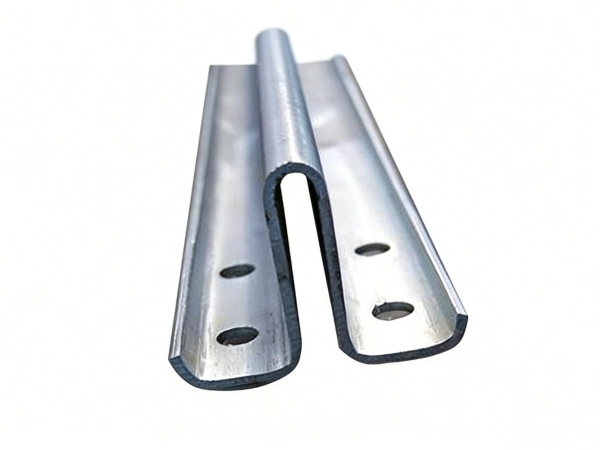
Flanged Hollow-Type Rails
Elevator guide rails are most commonly produced in T-shaped cross sections, known as T-type guide rails. These rails are categorized by their width, height, and mass per meter, which together determine their strength and rigidity.
Typical guide rail models include T45, T50, T70, T75, T82, T89, T90, T114, and T127. Among these, T70, T75, and T82 are widely used for passenger elevators, while T89, T90, and T114 are more common in freight elevators or high-load applications.
Standard guide rail lengths generally range from 4 meters to 5 meters per piece, allowing for easier transportation and installation. The rail size directly influences the elevator’s ability to resist bending, vibration, and lateral forces during operation.
Elevator guide rail dimensions are governed by internationally recognized standards to ensure safety and compatibility. The most commonly referenced standards include ISO 7465, EN 81-20/EN 81-50, GB/T 22562, and JIS standards.
These standards specify allowable tolerances for rail straightness, twist, surface finish, and dimensional accuracy. Precision in these parameters is essential, as even minor deviations can affect ride comfort and guide shoe wear.
Compliance with international standards also ensures that guide rails are compatible with common elevator components such as guide shoes, brackets, fishplates, and fastening systems, making installation and maintenance more efficient.
Different elevator types require different guide rail sizes based on load, speed, and usage frequency.
For passenger elevators, especially in residential and commercial buildings, mid-sized rails such as T70 or T75 are commonly used. These sizes provide sufficient rigidity while maintaining cost efficiency.
In freight elevators, where heavier loads and higher impact forces are expected, larger rails like T89, T90, or T114 are preferred. These rails offer increased mass and stiffness, reducing vibration and deformation under heavy loads.
High-speed and high-rise elevators often require larger or reinforced guide rails to maintain stability at increased speeds, while machine-room-less (MRL) elevators may use optimized rail sizes to balance space constraints and performance requirements.
Guide rail size has a direct impact on elevator performance. Larger elevator guide rails provide greater resistance to bending and torsion, which improves ride smoothness and reduces noise and vibration.
Smaller rails may be adequate for low-speed or low-load elevators, but insufficient rail size can lead to rail deflection, increased guide shoe wear, and reduced service life. In contrast, oversized rails can increase material costs and installation complexity without delivering proportional benefits.
The optimal guide rail size ensures stable vertical guidance, consistent alignment, and long-term operational reliability, particularly in elevators operating at higher speeds or with frequent starts and stops.
Selecting the right elevator guide rail size requires consideration of several key factors, including rated load, elevator speed, travel height, building structure, and applicable standards.
Project engineers should also account for installation conditions, bracket spacing, and long-term maintenance requirements. Consulting both elevator manufacturers and guide rail suppliers helps ensure that the selected size meets technical and regulatory requirements.
Ultimately, choosing the correct guide rail size improves elevator safety, enhances ride comfort, and reduces lifecycle costs, making it a critical decision in any elevator project.