
Kamień węgielny naszego sukcesu
Elevator guide rails are structural backbone of any lift system. They ensure car and counterweight travel in precise vertical path, absorb lateral forces, and maintain ride comfort and operational safety. Selecting wrong rail profile can result in vibration issues, accelerated wear, installation complexity, or unnecessary cost.
As an engineer with extensive experience in elevator mechanical systems and guide rail manufacturing, I will break down structural differences, performance characteristics, application suitability, and cost implications of three mainstream profiles:
1. T-Type guide rails
2. Flanged Hollow guide rails
3. Flat-Edged Hollow guide rails
This technical comparison will help elevator manufacturers, contractors, and project engineers determine which elevator guide rail type is best for specific project requirements.
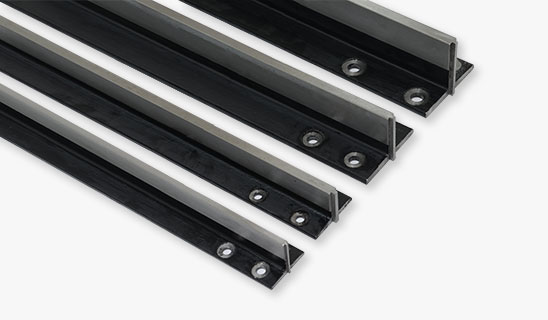
T-Type guide rails are traditional solid steel rails with a “T” cross-sectional geometry. They are typically produced through hot rolling and precision machining to ensure straightness and surface accuracy.
Structural characteristics:
• Solid web and head design
• High moment of inertia
• Excellent rigidity under bending stress
• Heavy weight per meter
Because of their mass and solid profile, T-Type rails provide superior structural stiffness and are widely used in high-rise elevators and heavy-duty freight elevators.
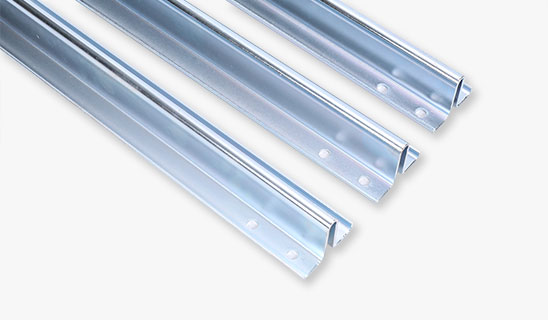
Flanged Hollow guide rails are hollow structural sections designed with reinforced flanges on both sides. The hollow core reduces material consumption while maintaining adequate rigidity through geometric optimization.
Structural characteristics:
• Hollow internal cavity
• Reinforced outer flanges
• Reduced weight compared to T-Type
• Improved material efficiency
This design improves strength-to-weight ratio and simplifies handling and installation.
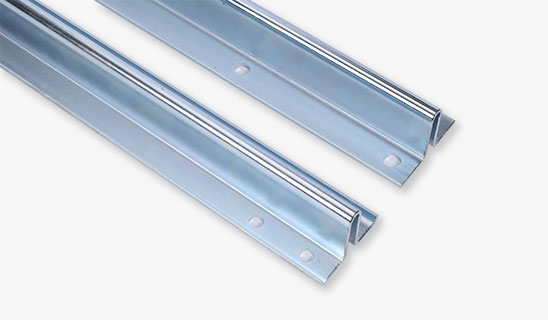
Flat-Edged Hollow rails are also hollow but without pronounced flanges. The outer profile is flatter, offering more compact dimensions.
Structural characteristics:
• Hollow interior
• Flat outer surfaces
• Lightweight structure
• Simplified installation interface
They are commonly applied in medium-load passenger elevators and modern machine-room-less (MRL) elevator systems where weight reduction is critical.
Load-bearing capacity is primarily determined by:
• Section modulus
• Moment of inertia
• Material grade (usually Q235B, Q345B or equivalent structural steels)
• Rail head hardness and machining precision
T-Type rails exhibit highest bending resistance due to solid web design. In high-rise installations where rail length increases lateral deflection risk, T-Type rails provide superior alignment stability.
Flanged Hollow rails achieve comparable rigidity by increasing flange thickness and optimizing geometry, but they typically do not exceed solid T-Type rails in ultimate stiffness.
Flat-Edged Hollow rails provide sufficient rigidity for mid-speed and mid-rise elevators but are not ideal for heavy freight or ultra-high-rise applications.
In traction elevators, guide rails mainly resist:
• Lateral forces from car movement
• Safety gear braking forces
• Emergency stop impact loads
T-Type rails perform best under safety gear activation due to their solid structure. Hollow rails must be precisely engineered to prevent local deformation under sudden stress concentration.
Mass plays significant role in vibration damping.
• T-Type: Better inherent damping due to higher mass
• Flanged Hollow: Balanced damping and weight reduction
• Flat-Edged Hollow: Lower mass, may require precise installation to avoid vibration issues
For high-speed elevators (>2.5 m/s), structural stiffness becomes increasingly critical.
Selecting correct elevator guide rail type depends heavily on elevator application.
For standard residential and commercial passenger elevators:
• Flat-Edged Hollow rails are often sufficient
• Flanged Hollow rails provide better long-term structural margin
• T-Type rails are used in premium or high-rise projects
Modern machine-room-less elevators benefit from hollow rail weight reduction, simplifying installation logistics.
Freight elevators impose higher static and dynamic loads.
Recommended choice:
• T-Type guide rails (heavy-duty applications)
• Flanged Hollow rails (medium-load industrial settings)
• Flat-Edged Hollow rails are generally not preferred for heavy cargo systems.
In high-speed traction elevators:
• Rail straightness tolerance becomes critical
• Dynamic forces increase significantly
• Safety gear loads intensify
T-Type rails remain most reliable solution for high-speed and high-rise projects.
Flanged Hollow rails may be used if engineered with sufficient section modulus and installed with strict alignment control.
• Choose T-Type guide rails for high-rise, heavy-load, and high-speed elevators where structural rigidity and safety margin are primary concerns.
• Choose Flanged Hollow guide rails for projects seeking optimized strength-to-weight ratio and cost efficiency without compromising reliability.
• Choose Flat-Edged Hollow guide rails for standard passenger elevators and MRL systems where lightweight design and installation efficiency are priorities.
There is no universally “best” elevator guide rail. Optimal selection depends on engineering calculation, building specification, and lifecycle expectation.
If your goal is performance reliability under extreme conditions, T-Type remains benchmark standard.
If your goal is structural efficiency and cost optimization, hollow guide rails represent modern evolution in elevator rail design.
Professional evaluation of load calculation, section modulus, and installation constraints should always precede final procurement decision.